Scholarly Communication
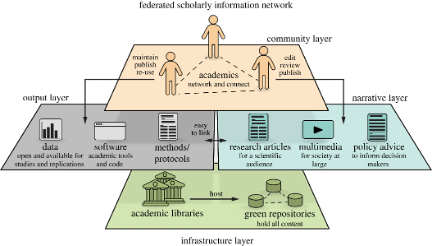
The current academic publishing system — dominated by a small number of commercial publishers — is costly, restrictive, and misaligned with the interests of science and society. This research line develops theoretical models and practical tools to support a transition toward scholar-governed, open-access publishing.
A long engagement with scholarly communication and research evaluation led to the founding of Open Scholar, an international organisation of researchers committed to developing and promoting alternatives to today’s problematic model of academic publishing. Our work spans peer review reform, overlay journals, institutional repositories, and the broader political economy of open access.
Journal Articles
-
Brembs, B., Huneman, P., Schönbrodt, F., Nilsonne, G., Susi, T., Siems, R., Perakakis, P., Trachana, V., Ma, L., & Rodriguez-Cuadrado, S. (2023). Replacing academic journals. Royal Society Open Science, 10(7), 230206. doi: 10.1098/rsos.230206
A blueprint for replacing traditional journals with a modular, scholar-governed infrastructure built on institutional repositories and open peer review.
-
Bernal, I., & Perakakis, P. (2023). No-pay publishing: use institutional repositories. Nature, 619(7971), 698. doi: 10.1038/d41586-023-02315-z
A correspondence arguing that institutional repositories already provide the infrastructure for free, immediate open-access dissemination without APCs.
-
Mosquera-de-Arancibia, C., & Lorenzo, E. (2017). OPRM: Challenges to including open peer review in open access repositories. Code4Lib, 35.
Examines the technical and social challenges of integrating transparent peer review workflows into existing open-access repository platforms.
-
Taylor, M., Perakakis, P., Trachana, V., & Gialis, S. (2014). Rankings are the sorcerer's new apprentice. Ethics in Science and Environmental Politics, 13(2), 73–99. doi: 10.3354/esep00137
A critical analysis of university ranking systems, arguing that they function more as tools of power than as meaningful measures of academic quality.
-
Perakakis, P., & Taylor, M. (2013). Academic self-publishing: a not-so-distant future. Prometheus, 31(3), 257–263. doi: 10.1080/08109028.2014.891712
Explores a near-future scenario in which scholars bypass traditional publishers altogether using open repositories and community-driven peer review.
-
Perakakis, P., Taylor, M., Mazza, G. M., & Trachana, V. (2011). Understanding the role of open peer review and dynamic academic articles. Scientometrics, 88(2), 669–673. doi: 10.1007/s11192-011-0402-1
Introduces the concept of dynamic academic articles that evolve through open post-publication peer review, replacing static PDF-based publishing.
-
Perakakis, P., Taylor, M., Mazza, M., & Trachana, V. (2010). Natural selection of academic papers. Scientometrics, 85(2), 553–559. doi: 10.1007/s11192-010-0253-1
Proposes an evolutionary model of scientific publishing in which open post-publication review acts as a selection mechanism for scholarly work.
-
Perakakis, P., Taylor, M., & Trachana, V. (2010). The roads to open access. World Social Science Report 2010, UNESCO Publishing, Paris.
An overview of open-access publishing models and their prospects, contributed to the UNESCO World Social Science Report.
-
Taylor, M., Perakakis, P., & Trachana, V. (2007). The siege of science. Ethics in Science and Environmental Politics, 8(1), 17–40. doi: 10.3354/esep00086
A foundational critique of the commercial takeover of academic publishing and its effects on the free circulation of scientific knowledge.
-
Perakakis, P., Taylor, M., Buela-Casal, G., & Checa, P. (2005). A neuro-fuzzy system to calculate a journal internationality index. CEDI Proceedings, Granada, Spain.
Introduces a fuzzy-logic approach to quantifying the international reach of academic journals based on multiple bibliometric indicators.
Invited Talks
-
Perakakis, P. (2026). The case for open infrastructures in research assessment. EU ERA Forum (European Commission), Online.
Opening talk at the European Commission's ERA Forum session on the synergies between research assessment reform and open infrastructures.
-
Perakakis, P. (2026). Alternative publishing models and evaluation. CSIC Predoctoral Network, Online.
Online talk at the CSIC Predoctoral Network's session on alternative evaluation models.
-
Perakakis, P. (2026). El negocio de la evaluación científica: alternativas desde la comunidad académica y las instituciones. Jornadas de Investigación, Facultad de Ciencias Políticas y Sociología (UCM), Madrid, Spain.
Análisis de los problemas estructurales del sistema actual de evaluación de la investigación y las iniciativas que están emergiendo para transformarlo.
-
Perakakis, P. (2026). Replacing Academic Journals. University of Montpellier, Montpellier, France.
Invited seminar on replacing commercial journals with scholar-governed, repository-based open infrastructure.
-
Perakakis, P. (2025). Reforma de la evaluación impulsada por CoARA en la UCM. International Open Access Week 2025, UCM Library, Madrid, Spain.
Invited talk on CoARA-driven research evaluation reform.
-
Perakakis, P. (2025). El negocio de las editoriales académicas y modelos alternativos. Jornadas de Cultura Laboral en Investigación (DigniMad), Madrid, Spain.
Invited lecture on the business model of academic publishers and non-commercial alternatives.
-
Perakakis, P. (2024). Guía del autoestopista hacia la libertad académica. Open Science Course, SEPNECA/SEPEX/SEPSICOBIO/UAM, Madrid, Spain.
Invited talk on navigating academic freedom in the context of open science.
-
Perakakis, P. (2023). Innovación en prácticas de revisión por pares. International Open Access Week, REBIUN, Spain.
Invited talk on innovations in peer review practices for open access publishing.
-
Perakakis, P. (2023). Innovación en prácticas de revisión por pares. Conference on the Foundations for the Advancement of Open Science, CSIC, Cuenca, Spain.
Invited talk on innovations in peer review at the CSIC open science conference.
-
Perakakis, P. (2023). Open Science with public infrastructure. Eötvös Loránd University, Budapest, Hungary.
Talk arguing for publicly-owned, scholar-governed infrastructure as the foundation for open science.
-
Perakakis, P. (2023). DeMéritos de la investigación científica. Jornada Inter-CRECS 2023, Madrid, Spain.
Invited round-table discussion on perverse incentives in scientific research evaluation.
-
Perakakis, P. (2022). Ciencia abierta y su implicación en la evaluación de la investigación. 44th Annual Congress of the Sociedad Española de Bioquímica y Biología Molecular, Malaga, Spain.
Round-table on open science and its implications for research evaluation.
-
Perakakis, P. (2022). Open Science: El papel de las revistas académicas. Colegio Oficial de Psicólogos, Madrid, Spain.
Invited conference on the role of academic journals in open science.
-
Perakakis, P. (2021). The Hitchhiker's Guide to Academic Publishing. New York University (NYU), Psychology Department, Online.
Invited talk surveying the history, problems, and alternatives to commercial academic publishing.
-
Perakakis, P. (2021). Science Collaboration and Open Science. 1st Crowdfight Symposium on the Science of Collaboration, Online.
Roundtable panelist on the role of open science in fostering scientific collaboration.
-
Perakakis, P. (2021). ¿Hay vida más allá de las editoriales? La revista Psicológica y la nueva generación de comunicación científica. Annual Conference of the Sociedad Española de Psicología Experimental (SEPEX), Online.
Keynote address on the future of scholar-owned journals and the next generation of scholarly communication.
-
Perakakis, P. (2019). La crisis de replicabilidad en Psicología: problemática y propuestas. Programa de doctorado en Psicología: Ciencia abierta, replicabilidad y evidencia científica, University of Seville, Sevilla, Spain.
PhD course lecture on the replicability crisis in psychology and proposed solutions.
-
Perakakis, P. (2017). Open Science: What, Why, How?. Hot Topic Lecture, Ghent University, Ghent, Belgium.
Hot Topic Lecture introducing open science principles, motivations, and practical tools.
-
Perakakis, P. (2017). Open Science in an Open World. 2nd Homo Scientificus Europaeus Meeting, Barcelona, Spain.
Invited talk on the relationship between open science and wider societal openness.
-
Perakakis, P. (2017). Why True Science is only Open Science. EURODOC2017, Oslo, Norway.
Presentation arguing that openness is a precondition for genuine scientific practice.
-
Perakakis, P. (2016). "One damned thing after another": The journal monopoly, how it came to be, what it means for science and what we can do about it. GATE CNRS, Lyon, France.
Invited lecture tracing the history of the commercial journal monopoly and paths toward reform.
-
Perakakis, P. (2016). An Open Peer Review Module for Open Access Repositories. Open Repositories 2016, Dublin, Ireland.
Presentation of the OPRM — a software module integrating structured open peer review into open-access repositories.
-
Perakakis, P. (2016). Open Peer Review workshop. Goettingen University, Goettingen, Germany.
Workshop on open peer review models, their benefits and limitations.
-
Perakakis, P. (2016). Presenting the first Open Peer Review Module for Open Access Repositories. CSIC, Madrid, Spain.
Presentation of the OPRM software at CSIC, the first open peer review module designed for integration with open-access repositories.
-
Perakakis, P. (2016). Next generation repositories. COAR Annual Meeting, Vienna, Austria.
Presentation on the vision for next-generation open-access repositories.
-
Perakakis, P. (2015). Modelos alternativos de validación y evaluación de la producción académica. Seminario sobre visibilidad y divulgación de la producción científica, University of Granada, Granada, Spain.
Invited seminar on alternative models for the validation and evaluation of academic production.
-
Perakakis, P. (2014). New systems for scientific evaluation, peer-review and open access. CSIC Open Access Week, Madrid, Spain.
Invited workshop presenting emerging alternative systems for scholarly evaluation and open-access dissemination.
-
Perakakis, P. (2013). Beyond Open Access: facing the real problems. Ludwig Maximilian University, Munich, Germany.
Invited lecture arguing that open access alone is insufficient and addressing the deeper structural problems of academic publishing.
-
Perakakis, P. (2013). Open, Portable, Decoupled – How should Peer Review change?. SpotOn London 2013, London, UK.
Presentation advocating for peer review decoupled from journals and portable across platforms.
-
Perakakis, P. (2013). Open Access to Scientific Reviews: Quantifying the opinion of peers. EUI Roundtable on Open Access Publishing, European University Institute, Florence, Italy.
Talk at the EUI Open Access Week roundtable on making peer review outputs openly accessible and quantifiable.
-
Perakakis, P. (2013). Current academic publishing and the LIBRE alternative. CERN Workshop on Innovations in Scholarly Communication (OAI8), University of Geneva, Geneva, Switzerland.
Presentation introducing the LIBRE platform as an alternative to the current academic publishing model.
-
Perakakis, P. (2007). How the impact factor power law came to be and the new alternatives. European Association of Science Editors (EASE), Barcelona, Spain.
Talk on the history of the impact factor and emerging bibliometric alternatives.
-
Perakakis, P. (2006). Putting the impact factor in its place with a new approach in bibliometry. Mediterranean Editors & Translators (METM), Barcelona, Spain.
Presentation proposing a new bibliometric approach to contextualise and replace the impact factor.
Courses & Workshops
An invited doctoral course on open science, research integrity, and the reform of research evaluation, delivered within doctoral programmes across Spain — Complutense University of Madrid, University of Málaga, University of Jaén, and others. The course translates this research line into hands-on training for early-career researchers.
Reproducible Research & Open Science — details, editions & venues
In the News
-
Are University ratings useful?
Commentary on the usefulness of university rankings.
-
Feature on the LIBRE project and journal-independent open peer review.
-
Open-access platform Libre launched
News story by Paul Jump on the launch of the LIBRE open peer review platform.
-
Times Higher Education piece by Paul Jump on research evaluation.
-
Press release announcing Open Scholar C.I.C. and the LIBRE project.